
How accurate is Apple RoomPlan?
Short answer
Accurate where floor plans need it. In a 2026 peer-reviewed test against a laser scanner, a RoomPlan app found every room in three buildings, got total wall area within 2% and drew room shapes that overlapped the laser model 0.84 to 0.93.[1] Its weak points are wall thickness and drift along long exterior walls.[1]
What RoomPlan is
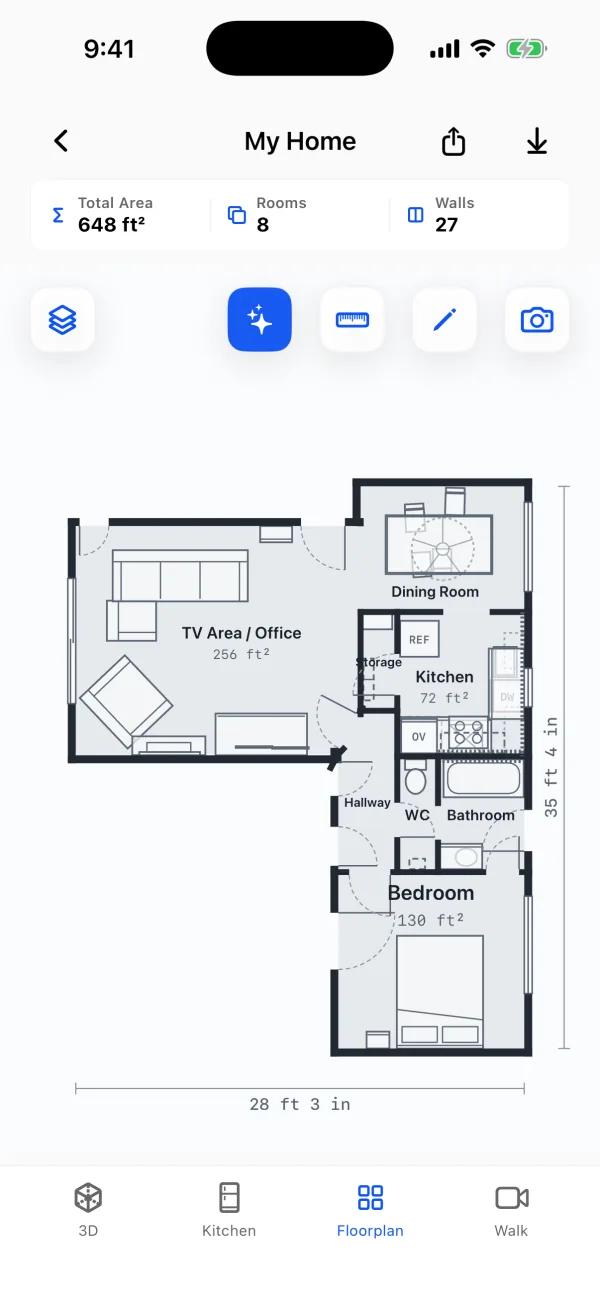
RoomPlan is Apple's room-scanning framework for iPhone and iPad. It reads the camera and the LiDAR Scanner together, uses trained models to find walls, windows, openings and doors, recognizes furniture and appliances, and returns the room as measured, editable geometry rather than a cloud of points.[2] PlaceAnew is built on it, and so are several other floor plan apps. Apple does not publish an accuracy figure for RoomPlan, so the evidence has to come from independent tests.
The best independent test: a house and two office floors
In 2026, Ersoz and Bosché published a peer-reviewed comparison at ISARC, the main conference on automation in construction. They documented one house and two office floors twice: with an iPad Pro running Metaroom, an app built on RoomPlan, and with a Leica BLK360 terrestrial laser scanner modelled by hand in Revit, which served as the reference.[1]
| Result | House | Office floor 1 | Office floor 2 |
|---|---|---|---|
| Rooms found | 8 of 8 | 7 of 7 | 5 of 5 |
| Room shape overlap with the laser model (1.00 is perfect) | 0.84 | 0.90 | 0.93 |
| Total wall area against the laser model | +1.9% | +0.1% | +0.3% |
| Total room area against the laser model | −4.9% | −6.3% | −5.2% |
| Time from scan to building model | 32 minutes for all three, against 20 hours with the laser scanner | ||
The authors' own reading: the app is highly effective at capturing the existence and length of walls, and its main strength is the room layout.[1] Every room, every wall, the right shape, in minutes. That is what a floor plan, a space plan or a remodeling estimate is built on.
Where RoomPlan is weaker
- Wall thickness. RoomPlan often falls back to a default wall thickness, so party walls and exterior walls are not measured as built.[1]
- Drift on exterior walls. Over a whole floor, small tracking errors shift the outer walls. Windows were recognized and sized correctly but sat on those shifted walls.[1]
- Extra doors. In the house the app found all the real doors and also read storage fronts as doors: 11 doors against 8.[1]
- Room area a little small. Total room area came out smaller than the laser model in all three buildings, by 4.9% to 6.3%.[1]
Apple's own guidance points the same way. RoomPlan works best in a residential room up to 30 by 30 feet, with at least 50 lux of light and single scans under 5 minutes; full-height mirrors and glass are hard for the sensor.[3] For whole homes, Apple designed multi-room scanning for single-floor houses up to about 2,000 square feet.[4]
How PlaceAnew deals with those limits
RoomPlan itself rates how sure it is about each wall, door, window, opening and object, as high, medium or low confidence.[5] PlaceAnew is open about the same thing on the plan: a wall it could not see is drawn dashed, and anything it estimated is marked "estimate". The editor lets you move a wall, add or change a door or window and rename a room, and Walk replays your scan so you can look at a corner again without going back.
We also checked PlaceAnew itself. In our own office, against a hand-measured floor plan, every wall length we could compare one to one came within 2.5 inches of the drawing, with a median difference under an inch, and the longest wall, 17' 2", came out a third of an inch long.[6] All eleven measurements, the weak ones included, are in How accurate is PlaceAnew?
RoomPlan accuracy vs raw LiDAR accuracy
Tests of the bare LiDAR sensor measure point-to-point distances; RoomPlan fits whole walls and rooms. Both matter. The sensor is tight on short spans, within 1-2 cm up to about 3 meters.[7] The details, long spans included, are in How accurate is iPhone LiDAR for room measurements?
Questions people ask
Does Apple publish an accuracy specification for RoomPlan?
No. Apple publishes the conditions RoomPlan works best in, such as room size, lighting and scan length, but no accuracy figure. Independent studies are the evidence, and PlaceAnew never quotes an accuracy figure in Apple's name.
Is RoomPlan as accurate as a laser scanner?
No, and it is not trying to be. In the ISARC study the laser workflow was the reference and took 20 hours; the RoomPlan app took 32 minutes and gave a reliable room layout.[1] For most remodeling, design and estimating work, that trade is the right one.
Was PlaceAnew the app in the study?
No. The study tested Metaroom, another app built on the same Apple RoomPlan technology. No public study has measured PlaceAnew yet; our method for doing it is in how to test a room scan app's accuracy.
What do I do with a RoomPlan scan?
Design, price and present from it. PlaceAnew marks the few places the scan could not see: walls drawn dashed and anything labelled "estimate". The editor fixes a wall, door or window in seconds, and Walk replays the visit so you can look at a corner again from the office.
Next step
See what this means for your plans in Can an iPhone make an accurate floor plan?, or for building work in Is LiDAR accurate enough for remodeling?
Sources
- A Comparative Study of Mobile Device and Terrestrial Laser Scanning-Based Scan-to-BIM Workflows (Ersoz and Bosché). ISARC 2026 proceedings, IAARC, 2026. Peer-reviewed study.
- RoomPlan framework documentation. Apple Developer, 2026. Official documentation.
- Create parametric 3D room scans with RoomPlan (WWDC22 session 10127). Apple Developer, June 2022. Official documentation.
- Explore enhancements to RoomPlan (WWDC23 session 10192). Apple Developer, June 2023. Official documentation.
- CapturedRoom.Confidence. Apple Developer, 2026. Official documentation.
- PlaceAnew office check, November 2026 (raw data, CSV). PlaceAnew, November 8, 2026. Our own measurement.
- Indoor mapping accuracy comparison between the Apple devices' LiDAR sensor and terrestrial laser scanner (Abdel-Majeed, Shaker, Abdel-Wahab, Awad). HBRC Journal, Taylor & Francis (open access), September 30, 2024. Peer-reviewed study.
Last reviewed November 8, 2026 by the PlaceAnew team at US Construction Remodeling Corp., a licensed California contractor (CSLB License #1117562).